Every few months a new headline appears: "AI will replace software developers within 2 years." It has been appearing for about 3 years now. During that same period, the demand for experienced software engineers has remained stubbornly high, salaries at the senior level have continued to grow, and companies are still competing fiercely for the best technical talent.
So what is actually happening? Is the AI threat overblown, or are we just not there yet? The answer is more interesting than either of those options.
1. AI Generates Code. It Does Not Build Businesses.
An AI model can write a correct sorting function in 2 seconds flat. It can generate a full React component from a text description, produce a SQL query from plain English, and refactor a messy function into clean, readable code. These are real capabilities, and they are genuinely useful.
What AI cannot do is sit in a client discovery call, listen to a founder describe their business model, ask the right clarifying questions, identify the technical constraint that makes their initial idea unworkable, and propose an alternative architecture that solves their actual problem. That process, translating ambiguous human intent into precise technical decisions, is the core of what senior engineers do every day.
- AI handles the syntax and the mechanical repetition of coding.
- Humans handle the context, the tradeoffs, and the accountability.
2. The New Workflow: AI as an Exoskeleton
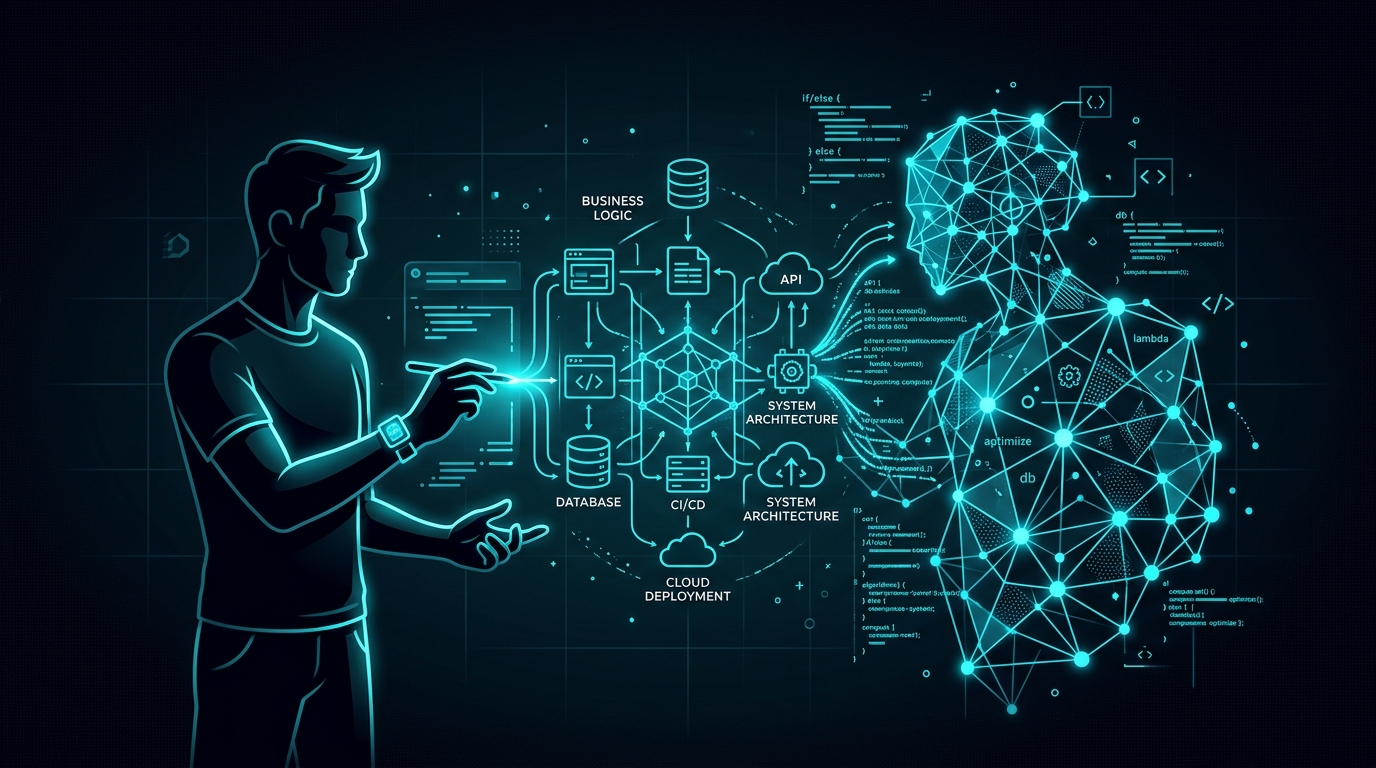
The most useful mental model for what is happening is that AI tools are an exoskeleton for software engineers. A good engineer with GitHub Copilot, Claude, and a well-configured development environment can produce in one day what used to take a full week. A 10x productivity multiplier is not an exaggeration for well-structured tasks with clear requirements.
This means businesses that hire AI-equipped engineers are getting dramatically more output per engineering dollar than businesses still operating the old way. It does not mean they are hiring fewer engineers. It means they are building faster, shipping more features, and competing with larger teams than they could afford before.
"AI is not a replacement for engineers. It is the most powerful tool engineers have ever had. The developers who embrace it become force multipliers for their entire organization."
3. The Jobs That Are Actually Changing
To be honest about it: AI is eliminating a specific kind of work. The work of converting a well-specified JIRA ticket with detailed acceptance criteria into exactly the implementation described is becoming faster and partially automatable. Junior developers who only do this kind of work, and do it slowly, are facing real competitive pressure.
What is not going away is the work of deciding what to build, how to architect a system that scales, how to debug production issues that have never appeared in a test environment, how to communicate technical risk to non-technical stakeholders, and how to make the dozens of underdetermined decisions every complex project involves. These require experience, judgment, and human accountability.
"AI is raising the floor for what developers can produce, but it is also raising the ceiling for what the best developers can achieve. The gap between average and great is getting wider, not smaller."
4. What Smart Businesses Are Doing
The businesses winning right now are not the ones asking "how many engineers can we replace with AI." They are asking "how do we equip our engineers to use AI so they can ship at a pace our competitors cannot match."
The practical result is teams that are slightly smaller but dramatically more effective. A team of 4 AI-equipped engineers often outships a traditional team of 10. For startups with limited runway, this is transformative.
The Bottom Line
Software engineers are not going anywhere. The demand for the kind of thinking that senior engineers provide, system design, technical leadership, complex debugging, architectural decision-making, is if anything increasing as software becomes more central to every business. What is changing is the baseline productivity expected at every level, and the premium placed on engineers who can effectively direct and leverage AI to multiply their output.