It is a fair question. If AI tools can generate a React component in 5 seconds, write a backend API endpoint from a text description, and produce unit tests automatically, why does building a quality mobile app still cost $15,000 to $50,000? Why hasn't the price of software development dropped the way the price of data storage or computing power did?
The answer is that people asking this question are, understandably, confusing code generation with software engineering. They are related, but they are not the same thing.
1. Code Generation vs. System Architecture
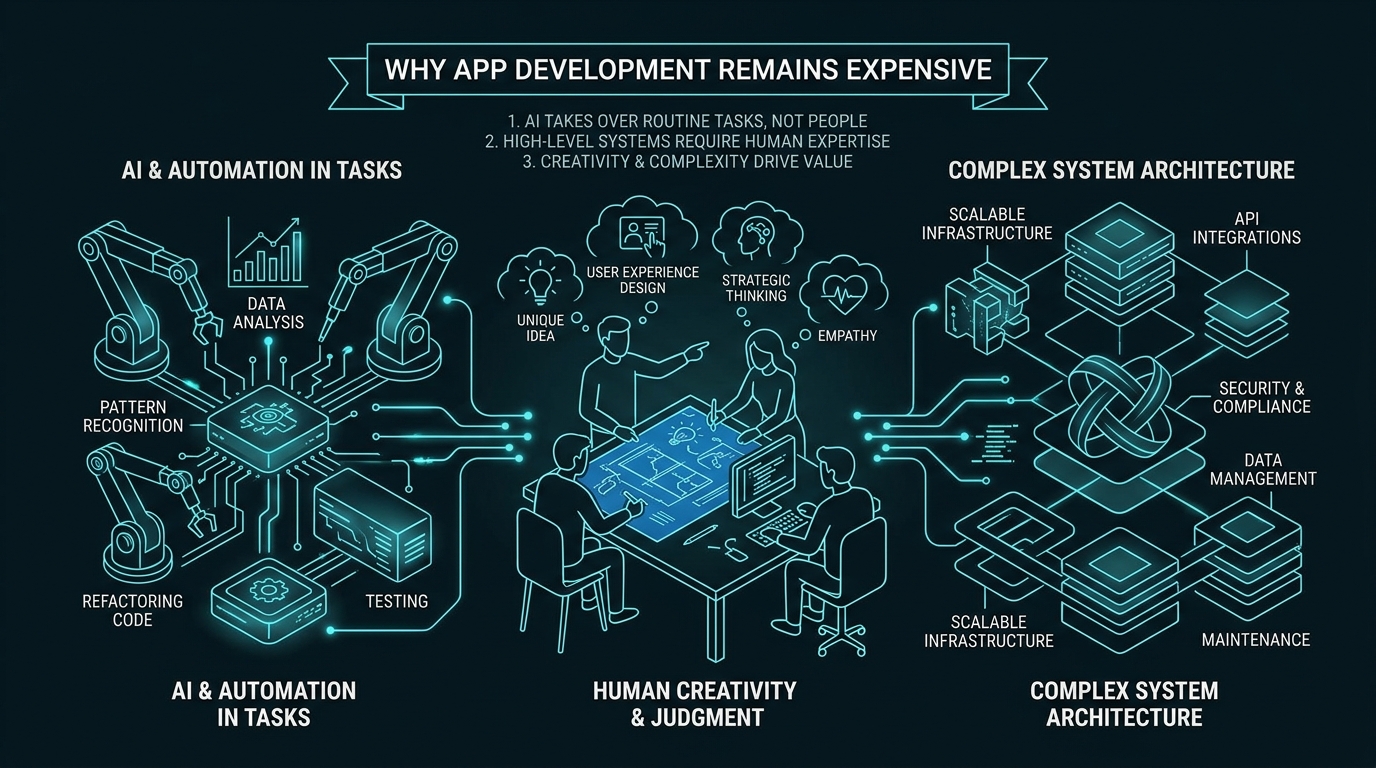
Writing individual functions, UI components, or API endpoints is the easiest part of building a software product. It is also the part AI is best at. What AI cannot reliably do is make the hundreds of architectural decisions that a complex application requires before a single line of production code is written.
How should the database be structured to support the query patterns this app needs at 10x the current user load? Which authentication strategy best balances security requirements and user experience for this specific use case? Where in the system should caching be introduced, and what cache invalidation strategy makes sense given how the data changes? These decisions compound over a project. A wrong decision early often means expensive rework months later.
"AI takes over the routine tasks of typing code, but it does not replace the accountable human architect who makes the decisions that determine whether the system actually works at scale."
2. Solving the Right Problem
Clients rarely know exactly what they need when they start a project. They come with a business problem and an initial idea about how software should solve it. Often the initial idea is partially wrong, sometimes significantly wrong. A good engineer listens carefully, asks clarifying questions, and shapes the technical solution around what will actually work for the business rather than what was literally requested.
An AI model asked to build exactly what was described will build exactly what was described, even if what was described is a poor solution to the underlying problem. It does not push back. It does not ask whether there is a simpler approach. It does not notice that the requested feature contradicts a business constraint mentioned in a different conversation. Human engineers do all of these things constantly, and this work is genuinely valuable even though it produces no visible output.
"The most expensive software projects are rarely the ones with the biggest feature lists. They are the ones that solved the wrong problem perfectly."
3. The Hidden Cost of AI Tokens
Here is a cost that most non-technical clients do not know to ask about: the cost of using AI models during development is not free, and it scales with the size and complexity of the project.
Every time a developer feeds code into an AI model, whether for review, refactoring, debugging, or generation, the model processes tokens. For a large, complex project with a 50,000 line codebase, providing meaningful context to an AI model for a non-trivial task can consume tens of thousands of tokens per interaction. Across hundreds of interactions over a multi-month project, these costs accumulate.
- Inexperienced developers using AI tools often provide unnecessary context and poorly structured prompts. They might paste entire files when only a function is relevant, or describe problems vaguely and require multiple back-and-forth exchanges to get a useful answer. This burns tokens without producing proportionally better output.
- Experienced developers know how to write precise prompts that give the AI exactly what it needs. They understand what context is relevant and what is noise. The result is dramatically better output with a fraction of the token consumption.
For a complex project where AI tooling is used heavily throughout development, the difference between efficient and inefficient AI usage can represent a meaningful additional cost in API fees, on top of the developer time cost.
4. Integration, DevOps, and Maintenance
Writing application code is roughly 30% to 40% of the total work in delivering a production software product. The rest is everything around the code: setting up cloud infrastructure, configuring CI/CD pipelines so that code changes get tested and deployed automatically, implementing monitoring and alerting so you know when something breaks before users tell you, handling App Store submissions and rejections, and maintaining the application after launch as operating systems update and dependencies break.
AI significantly speeds up some parts of this. Generating infrastructure configuration files, writing deployment scripts, and debugging CI failures are all areas where AI assistance is useful. But the holistic understanding of how all these pieces fit together for a specific deployment scenario still requires experienced human judgment.
"Launching an app is not the finish line. It is the starting line for an ongoing cost that includes hosting, updates, OS compatibility fixes, and user support. Budget for year two before you start year one."
5. The Shifting Value Equation
Here is the thing: app development costs have not dropped proportionally with AI adoption, but what you get for your budget has improved significantly. Projects that would have taken 6 months now take 6 weeks. Features that used to require a team of 5 now get built by a team of 2. Test coverage is higher. Codebases are cleaner. Documentation is more complete.
The cost of building software has not plummeted. But the return on that investment has increased substantially. The Return on Investment (ROI) on a well-executed software project in 2026 is meaningfully better than it was 5 years ago, even at similar nominal cost, because the quality and completeness of what gets delivered in that budget has improved dramatically.