
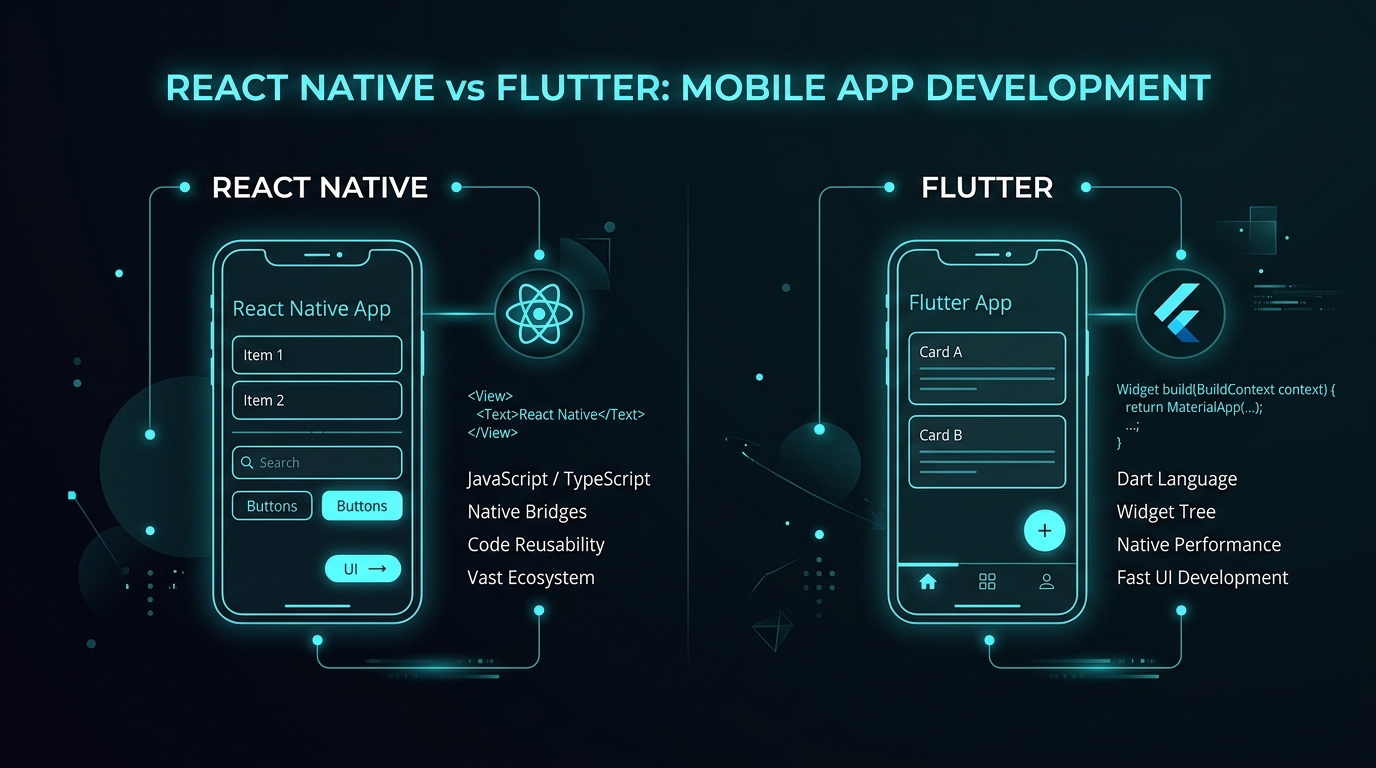
Choosing the right mobile framework is one of the highest-stakes technical decisions you will make for your product. Pick the wrong one and you end up rebuilding your entire app two years later. In 2026, the competition has fully narrowed to two frameworks: React Native and Flutter. Everything else is a distant third.
Both are mature, both are backed by large companies (Meta and Google respectively), and both can produce polished, high-performance applications. So how do you actually choose? Here is the complete breakdown.
1. Performance: The 60fps Benchmark
Performance was once Flutter's biggest selling point. Flutter bypasses native UI components entirely and draws everything using its own rendering engine, Impeller 2.0 in 2026. This means it consistently delivers 60 to 120fps even for complex, custom animations without relying on a native bridge.
React Native used to have a significant performance disadvantage because of its old JavaScript bridge architecture. That bridge is gone. With the completed rollout of the New Architecture (Fabric renderer and the JavaScript Interface), React Native now communicates with native modules synchronously. The result is near-native performance for the vast majority of business applications. Unless you are building a high-frame-rate game or something requiring extreme custom graphics, the performance difference is no longer a reason to choose one over the other.
- Flutter: Consistently hits 60-120fps with its own rendering engine. No native component overhead.
- React Native: Achieves native-like performance post-New Architecture. Uses real platform UI components, which means buttons and scroll views feel exactly native.
2. Developer Ecosystem and Talent Pool
This is where the decision gets practical for most businesses. React Native uses JavaScript and TypeScript, languages that over 65% of all web developers already know. If you have a web team built on React, your developers can contribute to your mobile app from day one. Code sharing between your web and mobile products becomes a genuine option, not just a marketing pitch.
Flutter uses Dart, a language designed by Google specifically for Flutter. Dart is clean and easy to learn, but the talent pool is roughly 5 to 8 times smaller than the JavaScript ecosystem in most hiring markets. If you need to scale your team quickly or find contractors for a specific feature, React Native almost always wins on hiring speed and cost.
"Hiring a React Native developer is faster and more cost-effective than finding a specialized Dart developer. In most Indian markets, senior Dart developers command a 20% to 30% premium over equivalent React Native engineers."
3. UI Consistency vs Native Feel
Flutter renders every pixel itself. This is a feature and a trade-off. You get perfect visual consistency across iOS and Android since the same code produces the exact same result on every device. This is incredibly valuable for apps with highly custom designs, like fintech dashboards or branded consumer apps.
React Native renders real native components. A button on iOS uses a real UIButton. A scroll view uses a real UIScrollView. This means your app automatically inherits the platform feel that users expect, accessibility features built into the OS, and any future UI improvements Apple or Google ships. There is no extra work to keep things feeling native because they are native.
"If your design team has a highly custom visual identity, Flutter gives you pixel-perfect control. If your users expect the standard iOS or Android feel, React Native is the faster, more natural path."
4. Development Speed
Both frameworks support Hot Reload, which lets you see UI changes instantly without restarting the app. This alone speeds up development by up to 40% compared to full native development cycles.
Cross-platform frameworks save you roughly 30% to 50% in total development cost compared to building two separate native apps. Instead of maintaining an iOS codebase in Swift and an Android codebase in Kotlin separately, you maintain one shared codebase for the majority of your business logic.
"In most business applications, choosing cross-platform over native saves 3 to 4 months of development time and cuts the total project cost almost in half."
The Bottom Line
For most startups and businesses, React Native is the safer choice in 2026. The hiring pool is larger, the JavaScript ecosystem is enormous, and performance is no longer a differentiator. If your app has extremely complex custom animations or needs to look pixel-perfect across every screen with zero variance, Flutter is the better tool. But for a typical SaaS app, a marketplace, or a business dashboard, React Native gets you to market faster with a team that is easier to hire and scale.