
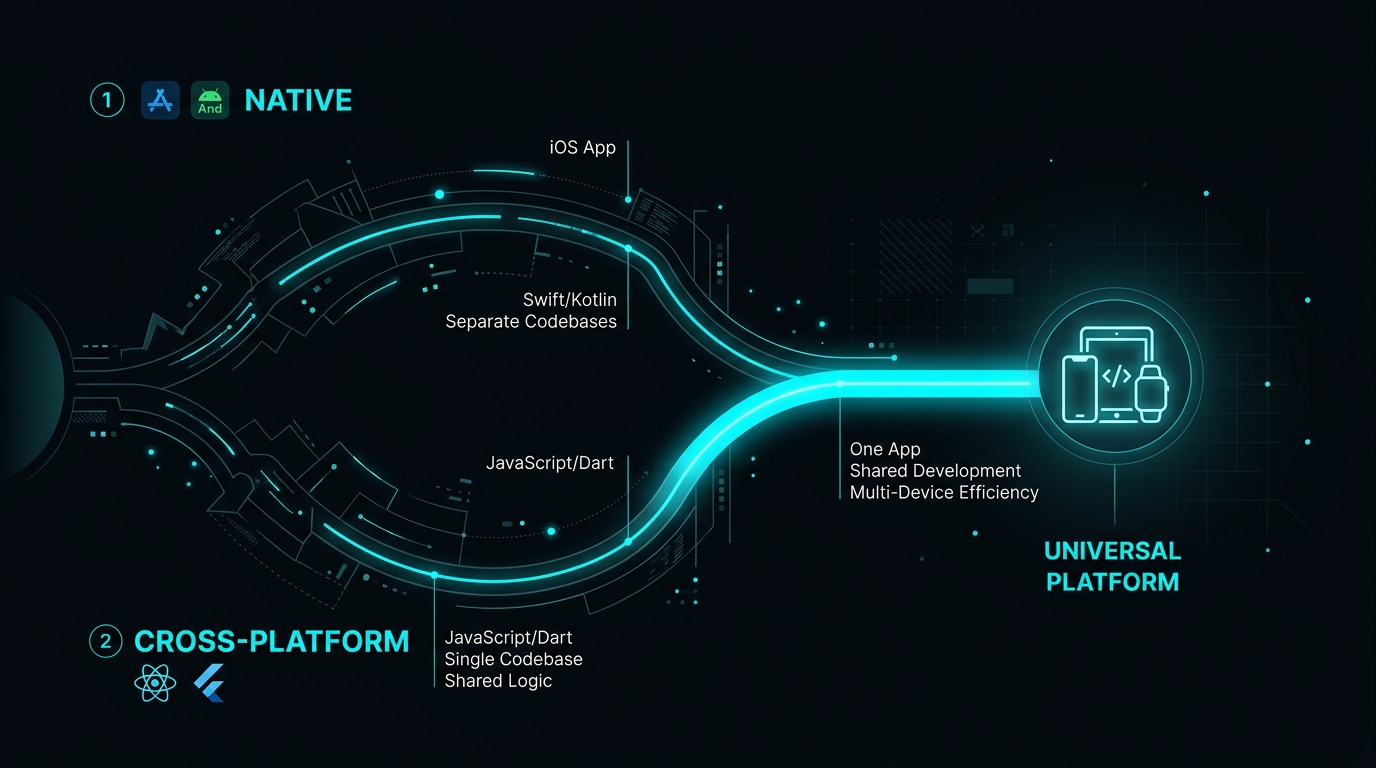
The decision between native and cross-platform development is one that most startups rush through and then spend years regretting. It shapes your hiring strategy, your budget, your team structure, and your ability to ship updates quickly. It is worth spending a full afternoon thinking it through before you commit.
The short version: for most businesses, cross-platform is the right answer. For a specific set of use cases, native is the only viable option. Here is how to know which side of that line your project sits on.
1. What Cross-Platform Actually Means
Cross-platform frameworks like React Native and Flutter let you write one shared codebase that compiles to both iOS and Android applications. This is not the same as wrapping a website in a mobile shell, which is what older hybrid frameworks like Cordova did. Both React Native and Flutter produce genuinely native applications that feel and perform like apps built in Swift or Kotlin.
The practical benefits are significant:
- Cost: Cuts development cost by up to 40% compared to building separate native apps. You are paying one team to build one codebase instead of two teams building two codebases.
- Speed: Bug fixes, feature additions, and UI changes go to both platforms simultaneously with a single deployment.
- Team Size: One unified team instead of separate iOS and Android teams who need to coordinate constantly to keep features in sync.
2. When Cross-Platform is the Right Choice
Cross-platform works well for the vast majority of B2C and B2B applications: marketplaces, SaaS tools, social apps, dashboards, e-commerce apps, productivity tools, and most service apps. If your app primarily involves data display, user interaction, and network calls, cross-platform handles it with no meaningful compromise.
In 2026, the performance gap that used to make native apps feel superior on certain interactions has largely closed. React Native's Fabric architecture and Flutter's Impeller engine both produce animations and UI interactions that users cannot distinguish from native in real-world use.
"If your app does not require advanced hardware access or pixel-perfect platform compliance, cross-platform is almost always the right starting point. You can always add native modules later for the 10% of features that need them."
3. When Native is Mandatory
There is a specific set of requirements where cross-platform genuinely cannot keep up, and building native is not a preference but a necessity:
- High-End 3D Graphics: Games or apps requiring GPU-intensive 3D rendering need direct access to Metal (iOS) or Vulkan (Android). Cross-platform frameworks introduce abstraction layers that cost you real frame rate performance in these scenarios.
- Deep Hardware Integration: Bluetooth Low Energy device communication, complex background audio processing, NFC for payment terminals, and advanced camera APIs like ProRAW on iPhone all require direct OS-level access that cross-platform bridges do not expose cleanly.
- Pixel-Perfect Platform Compliance: A banking app or a healthcare app that needs to pass Apple's App Review for highly regulated submissions sometimes requires exactly following the Human Interface Guidelines down to interaction patterns. Native gives you the tightest possible alignment with platform expectations.
"Native development for dual platforms typically starts at $50,000 for a quality release. That is not a reason to avoid it if your use case requires it, but it is a reason to be certain before committing."
4. The Hybrid Middle Ground
Some teams build with a cross-platform framework for 90% of the app and drop to native modules for the 10% that requires it. Both React Native and Flutter support native modules that let you write platform-specific Swift or Kotlin code for specific features while keeping the rest of the app cross-platform. This is a pragmatic approach that captures most of the cost benefits while handling edge cases correctly.
Making the Decision
If you are unsure, start with cross-platform. It is easier to add native modules for specific features later than it is to rebuild a native app in cross-platform after you realize the development cost is too high. The majority of apps that start cross-platform stay cross-platform. The ones that migrate to native almost always do so because of a very specific technical requirement that was not apparent at the start.