
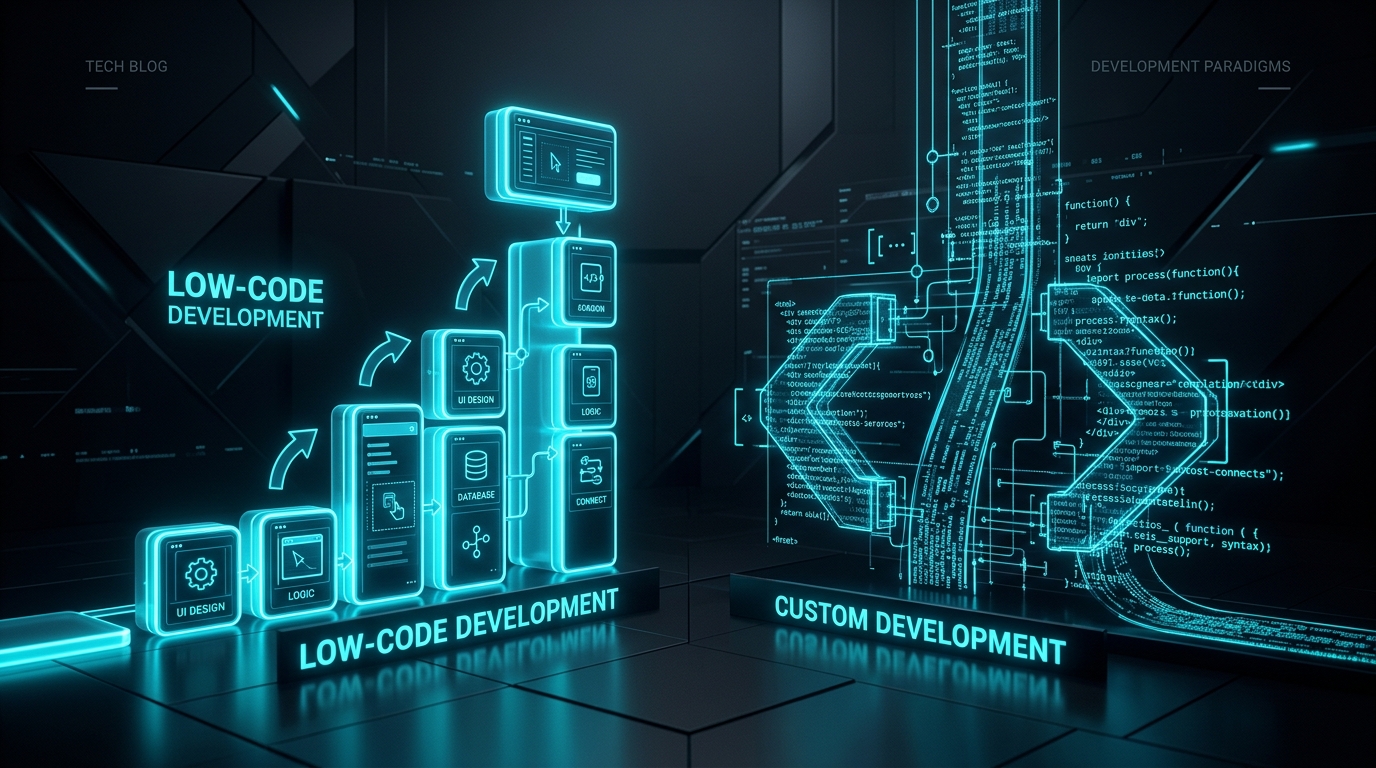
Low-code platforms like Bubble, Webflow, and Retool have come a long way. What used to be simple drag-and-drop tools for building basic websites can now power genuinely complex applications with databases, user authentication, payment flows, and API integrations. The tools are better than they have ever been.
So the question businesses are asking in 2026 is a real one: do we actually need a developer, or can we build this ourselves with the right platform? The answer is not as simple as "low-code is always cheaper" or "custom is always better." It depends on what you are building, how long you need it to last, and how important it is to your core business.
1. What Low-Code Does Well
Low-code is genuinely good for a specific category of business needs. If you are building internal tools, simple customer portals, landing pages with forms, or basic workflow automation, low-code platforms are often the fastest and most cost-effective option available.
The speed advantage is real. A developer building a basic admin dashboard in Retool can have something functional in 2 to 3 days that would take a traditional dev team 3 to 4 weeks to build from scratch. For internal tools where the user is your own team and design polish is not critical, that is a compelling trade-off.
"If the tool is for your team and not your customers, low-code almost always wins on speed and cost. The calculus changes the moment it becomes customer-facing."
2. Where Low-Code Hits Its Ceiling
The limitations of low-code platforms are real, and they tend to show up at the worst possible time, usually when your business is growing and you need to scale or customize urgently.
The three most common ceilings:
- Performance at Scale: Most low-code platforms are not built to handle high-traffic scenarios efficiently. When you reach thousands of concurrent users, you often find the platform's abstraction layer creates bottlenecks that you cannot optimize around.
- Custom Logic: Any business logic that is complex, conditional, or specific to your domain eventually outgrows what a visual editor can express cleanly. You end up writing workarounds that create technical debt inside the platform.
- Vendor Lock-In: Your entire product lives inside someone else's system. If the platform changes pricing, discontinues a feature, or shuts down, you are rebuilding from scratch anyway.
3. The Real Cost Comparison
The upfront cost of low-code looks attractive. No expensive developers, faster build time, and most platforms offer affordable monthly plans. But the total cost of ownership over 3 to 5 years tells a different story.
A Bubble app that costs $500 to build can cost $500 to $2,000 per month in platform fees as it scales. A custom app that costs $15,000 to build has hosting costs of maybe $100 to $300 per month indefinitely, and you own every line of it.
"Low-code is cheap to start and expensive to scale. Custom is expensive to start and cheap to maintain. Know which phase of the journey you are in before you decide."
4. Who Should Use What
Here is a practical framework for making the decision:
- Use low-code if: You are validating an idea before investing in custom development. Your product is an internal tool. You need something working in days, not weeks. The feature requirements are straightforward and unlikely to change significantly.
- Use custom development if: The product is your core business, not a side tool. You need specific performance, security, or compliance requirements. You plan to scale to thousands of users. The product needs to integrate deeply with your existing infrastructure or third-party systems.
5. The Hybrid Approach
A lot of smart businesses are using a middle path in 2026. They use low-code or no-code tools to validate quickly, then migrate the validated product to a custom build once they know exactly what they need. You learn what the product should be using cheap tools, then invest in building the real version correctly.
The key is planning for this migration from the start. If you build your low-code prototype knowing you will rewrite it later, you make different decisions about data structure and workflow than if you are trying to make the prototype last forever.
The Bottom Line
Low-code is a legitimate tool, not a shortcut. It solves real problems for the right use cases. But it is not a replacement for custom development when your product is the foundation of your business. The mistake is choosing based on upfront cost alone without thinking about where the product needs to be in three years.