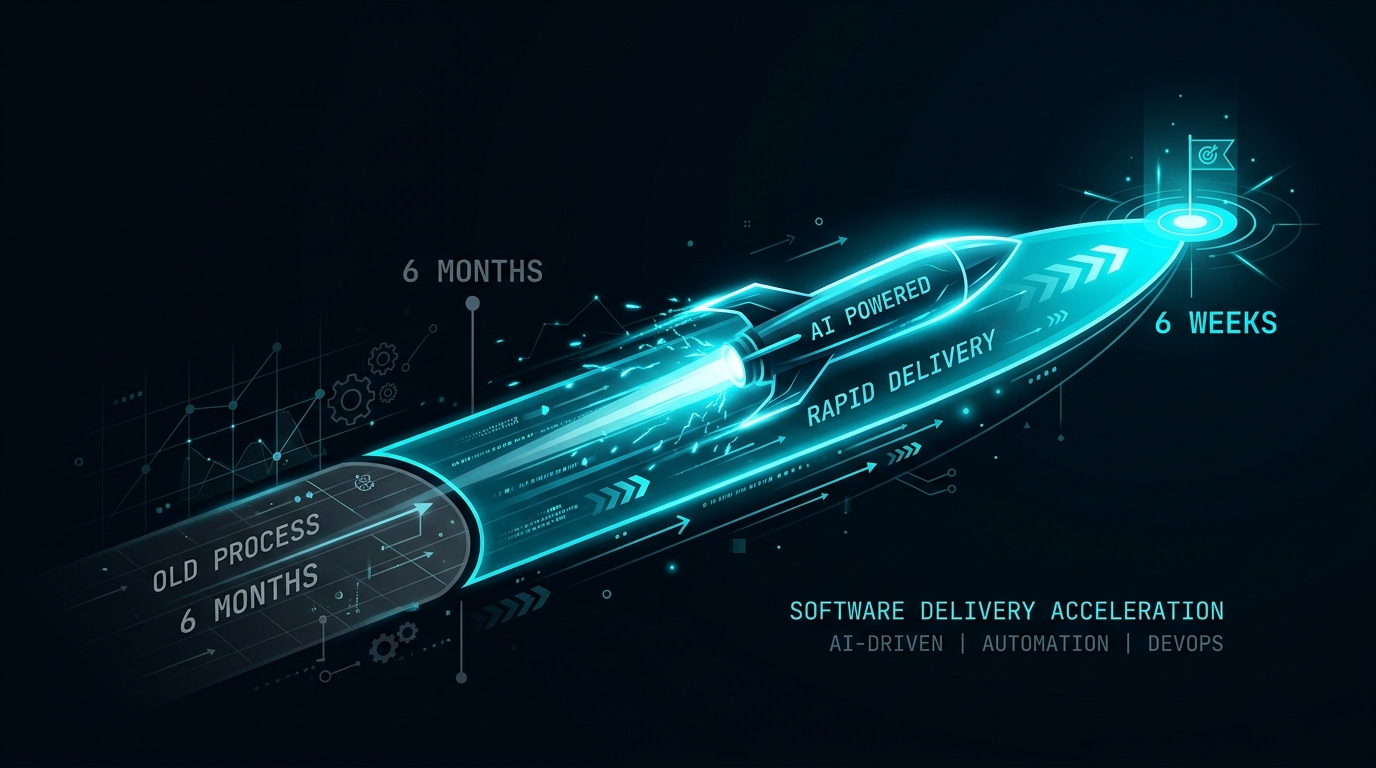
When I tell clients that a project that would have taken 5 to 6 months two years ago can now be delivered in 6 weeks, I get one of two reactions. Either skepticism that the quality must be suffering, or excitement that this changes their budget math entirely. Both are reasonable responses. Let me walk through exactly what has changed, and more importantly, where the compression comes from and where it does not.
This is not a generic "AI is amazing" piece. This is the specific workflow I use on real client projects, the tools involved, and an honest accounting of where AI helps enormously and where it still cannot replace engineering judgment.
1. Project Kickoff: Scaffolding in 30 Minutes
Starting a new project used to consume the first 2 to 3 days before any visible product work happened. Configure Webpack (or later Vite). Set up the TypeScript configuration. Integrate ESLint and Prettier. Wire up the authentication provider. Set up the CI/CD pipeline. Create the database connection layer. This is foundational work that needs to be done right, but none of it is unique to the specific product being built.
Today I can describe the exact technical requirements of a project to an AI model: the framework, the database, the authentication strategy, the API structure, the environment setup, and it generates a complete, correct foundation in minutes. I spend the 30 minutes after that reviewing every file, making adjustments to match my preferences and the specific project constraints, and verifying that the output is actually good. What used to take 3 days takes half a morning.
"The best use of AI in project setup is not to generate code blindly. It is to generate a solid foundation that an experienced developer then reads line by line, adjusts, and owns fully."
2. Feature Development: AI as Pair Programmer
The most tangible productivity gain during active development comes from having an AI assistant running in my editor constantly. Tools like GitHub Copilot predict what I need as I type. When I write the first few lines of a new function, the AI usually suggests the complete implementation. Sometimes it is exactly right. More often it needs small corrections, but starting from a reasonable draft is dramatically faster than starting from nothing.
The bigger productivity gain is eliminating context switching. Without an AI assistant, complex tasks require constant trips to documentation, Stack Overflow, and previous codebases to recall how to do something specific. With a good AI model in the loop, I can ask the question directly and get a precise answer in 3 seconds. This keeps me in a deep work flow state for 3 to 4 hours at a time instead of breaking concentration every 10 minutes.
3. Debugging: From Hours to Minutes
Debugging complex issues used to be one of the biggest time sinks in any project. Tracking down why a race condition happens intermittently in production, or why an edge case in the data model causes a specific API endpoint to return incorrect data under very specific circumstances, could take hours of careful analysis.
The workflow now: paste the stack trace, the relevant function, and a brief description of the expected versus actual behavior into an AI model. About 80% of the time, it identifies the root cause immediately. The other 20% requires iteration, but even then the AI surfaces hypotheses to test that cut the debugging time in half. A bug that would have taken 2 hours to find and fix often now takes 20 minutes.
4. Testing: Zero-Cost Coverage
Writing comprehensive unit tests used to be a discipline tax. Every developer knows tests are important. Writing them is tedious. The result was that test coverage was always lower than it should have been because engineers would rather build features than write tests for features they already understand.
AI eliminates this friction almost entirely. I highlight any function or module and ask the AI to generate a full test suite covering the happy path, edge cases, and error conditions. It produces a solid starting point in under 30 seconds. I review every test to ensure it is actually testing the right thing and not just passing trivially, but the generation time is effectively zero. My test coverage on AI-assisted projects is consistently higher than on projects I built before these tools existed.
"AI-generated tests still need human review. An AI will write a test that passes trivially without actually verifying the intended behavior. Reading every test before accepting it is not optional."
5. Where AI Cannot Help
The honest part: the 6 weeks to 6 months compression only applies to the mechanical implementation work. The thinking and decision-making that precedes and surrounds that implementation is still entirely a human responsibility.
Choosing the right database schema for the access patterns this specific application needs, deciding where to add caching versus where to optimize the query, understanding that the client's stated requirement is actually a symptom of a different underlying problem, knowing when a simple approach will fail at scale and when a complex approach is overkill, all of this still requires engineering experience and judgment. AI is very good at executing clear instructions. Knowing what instructions to give requires expertise that takes years to build.
The Real Shift
The 6-month to 6-week compression is real, but it requires a developer who can effectively direct AI tools, critically evaluate their output, and catch the subtle errors that AI models make with confidence. An inexperienced developer using AI can make a mess faster. An experienced developer using AI can build something genuinely good at a pace that was impossible 3 years ago.